

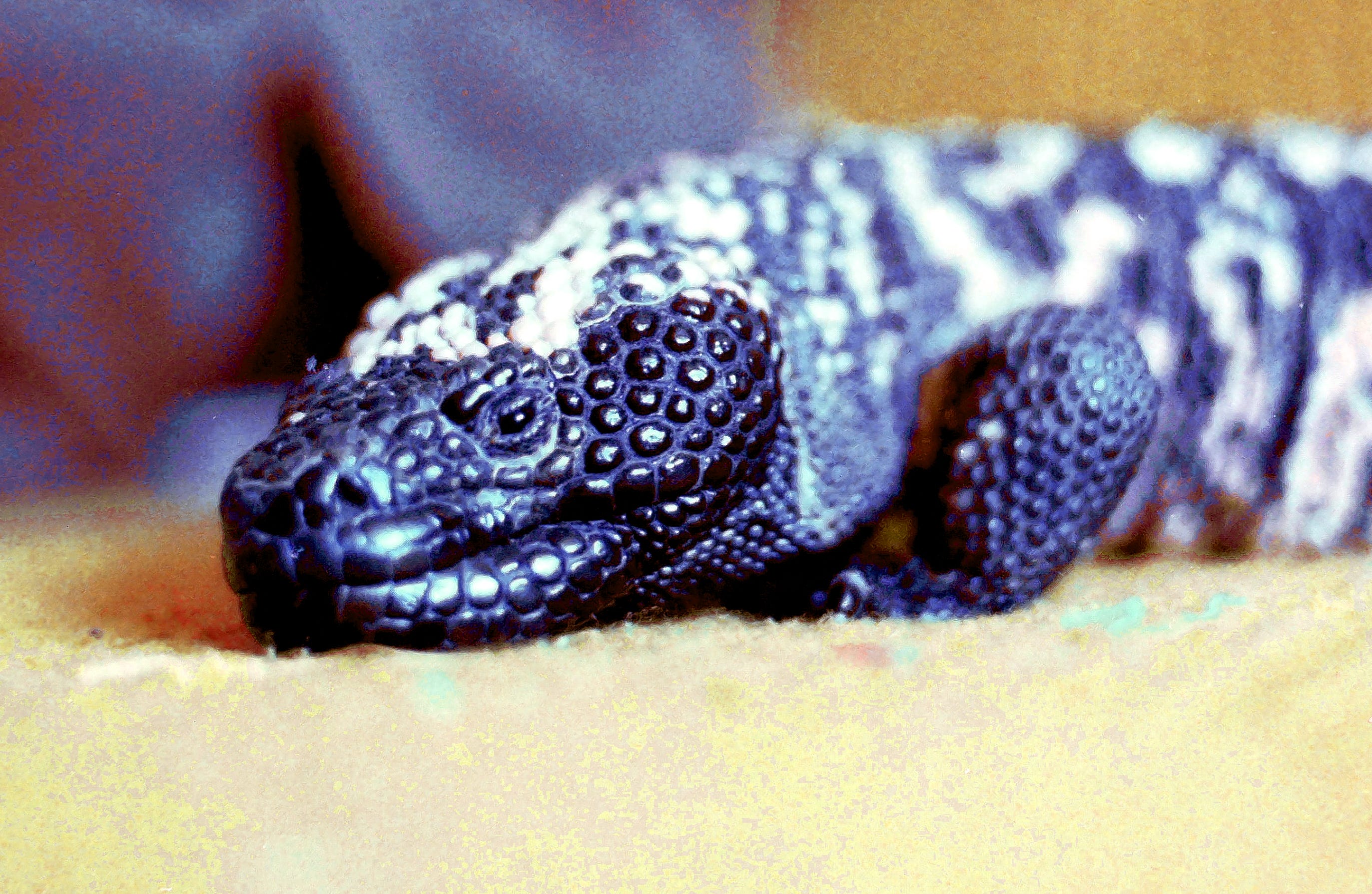
I (Mike) was recently going through some really old photos of animals and friends from my youth and young adult life. Memories of old times and special souls have been pouring back because of it... an amazing collection of wild and exotic beings that shaped an important part of my life. These non-humans taught me many things, including the fact that they have much more going on in their minds than we believe. They also taught me we might not have as much going on in ours as we think.
I have experienced injured wildlife accepting my aid and assistance, and then celebrating with gratitude later. I have lost (and pursued) a live baboon in the grocery store. I have met the demon seed, and he was a spoiled rotten, baby Orangutan who had realized that he could get away with anything, because he was just that special where ever he went.
I’ve kept venomous reptiles, like rattlesnakes and Gila monster. I’ve also kept bobcat, eagles, hawks, owls and falcons… I’ve smelled the insides of winter bear dens where mothers were nursing their cubs. I have been licked - in the face - by adult Siberian Tigers. I’ve been totally exhausted playing with their cubs. I have raised various invertebrates, including silkworms, wax worms and various roaches as food for other animals in my care.
Our second bedroom in a south Minneapolis home was converted into an infant bat nursery for one of my bat research projects. I have - literally - flown with eagles and crawled in the mud with worms. And I have a TON of stories to tell because of it. And, tell those stories I plan to!
We’ve added a new section to the Our Urban Farm website titled “Learned from Animals.” There, you will find some of the things these amazing animals have taught me over the years… beginning with this set of lessons from Lenny, the Gila monster.
Lenny was not the first Gila monster I ever handled. But, he was the first WILD Gila monster I ever handled. That is an important distinction, because, as a general rule, Gila Monsters are remarkably chill animals, once they get to know you. If they are getting their basic needs met and they are not being directly threatened, by, say, some giant 2-legged predator like me, they are super happy to take a live-and-let-live view of the world. At the same time, they rightly see humans as giant 2-legged predators that are threatening their lives. That is, until they learn otherwise. Fortunately for me, Lenny was a fast learner.
This is the story of the day Lenny - a wild-caught Gila monster - decided to be my friend. All it took was a gentle touch and a bit of body heat.
I was doing a live performance show called “Prisoners to Poison” that was an educational tribute to venomous (not “poisonous” as was discussed during the show) reptiles. I had a small collection of venomous animals that appeared in the show… a very large tarantula… a Western Diamondback Rattlesnake. Along with them, I had other animals people wrongly believed to be venomous (or “poisonous”), like harmless snakes. (FYI, poisonous = eating it; venomous = exposure to it, such as via bite)
During that time, I had the opportunity to buy a probably not-quite legally obtained, wild-caught Gila monster (Heloderma suspectum). Though the ethics seemed a bit sketchy, to have a Gila monster in my show… how could I resist?
The transaction took place down the back stairway in an unmarked industrial complex. There, a guy I was pretty sure I recognized from one of the local “pet stores” accepted my $250 cash and then handed me a wiggling cloth bag, tied with a knot in the top.
“Hold it above the knot and don’t touch the outsides of the bag,” he instructed.
Inside the bag was North American’s only venomous lizard (endangered and native to the desert southwest), with venom so strong it can kill you, but with a delivery system so primitive, it rarely does.
Unlike the effective hollowed, upper fangs of snakes that inject venom deep into tissue, the venom of Gila monsters is put into tissue from grooves in the teeth in the lower jaw that help direct venom into their prey when the lizards flip on their backs and use their powerful jaws to grind the lower teeth into the wound. It is very effective at killing small ground-dwelling animals, like nestling birds. It’s unlikely to kill a functioning adult human… unless that person is doing something remarkably stupid.
The “poison” of most venomous creates is often divided into a couple categories: Neurotoxic venom affects the nervous system, while hemotoxic venom damages blood cells and tissues. The venom of the Gila monster is both. Plus, it has some extra-special enzymes and other things that make it particularly problematic. It causes extreme pain, swelling and bleeding. Even if it doesn’t kill you, it may make you wish that it had.
I thought of all of those things the first time I decided to handle Lenny. Was I one of those stupid people who was only going to realize how stupid I was after this lizard latched onto my hand and refused to let go, venom slowly seeping into a painful wound?
I would find out a few days after bringing Lenny home.
The first day, all I did was carefully untie the cloth bag that confined him and carefully lay it in the large enclosure I had set up for him. He deserved some time to settle in, to get to know his new surroundings, to find his hide boxes, water, food and basking spots. I had no way of knowing how long he had been traveling, when the last time he had eaten was or what kind of trauma or stress he had experienced along the way.
The first couple of days, I rarely saw him. He spent most of his time hiding. If he was out and about in his enclosure and I lifted the lid on his 4-foot long habitat, he would arch his back, open his mouth and hiss loudly.
Lenny was not at all like the placid, very mellow, long-time captive Gila monsters I had handled before him. Most of them were so docile it was easy to forget they packed a mouthful of painful venom that might be able to kill you if you did something really stupid. I thought about that when I went to pick him up for the first time. I mean, what if I was one of those really stupid people who only realized how stupid they are when it is already too late?
On the day I decided to pick him up for the first time, Lenny was out and about exploring his enclosure. I flipped the hinged lid open. He lifted he head, opened his mouth and hissed loudly.
I used a stick to gently pin him to the floor of his habitat. Once pinned, I used one hand to carefully wrap my index and middle fingers around one of his front legs. I used my thumb around the other front leg.
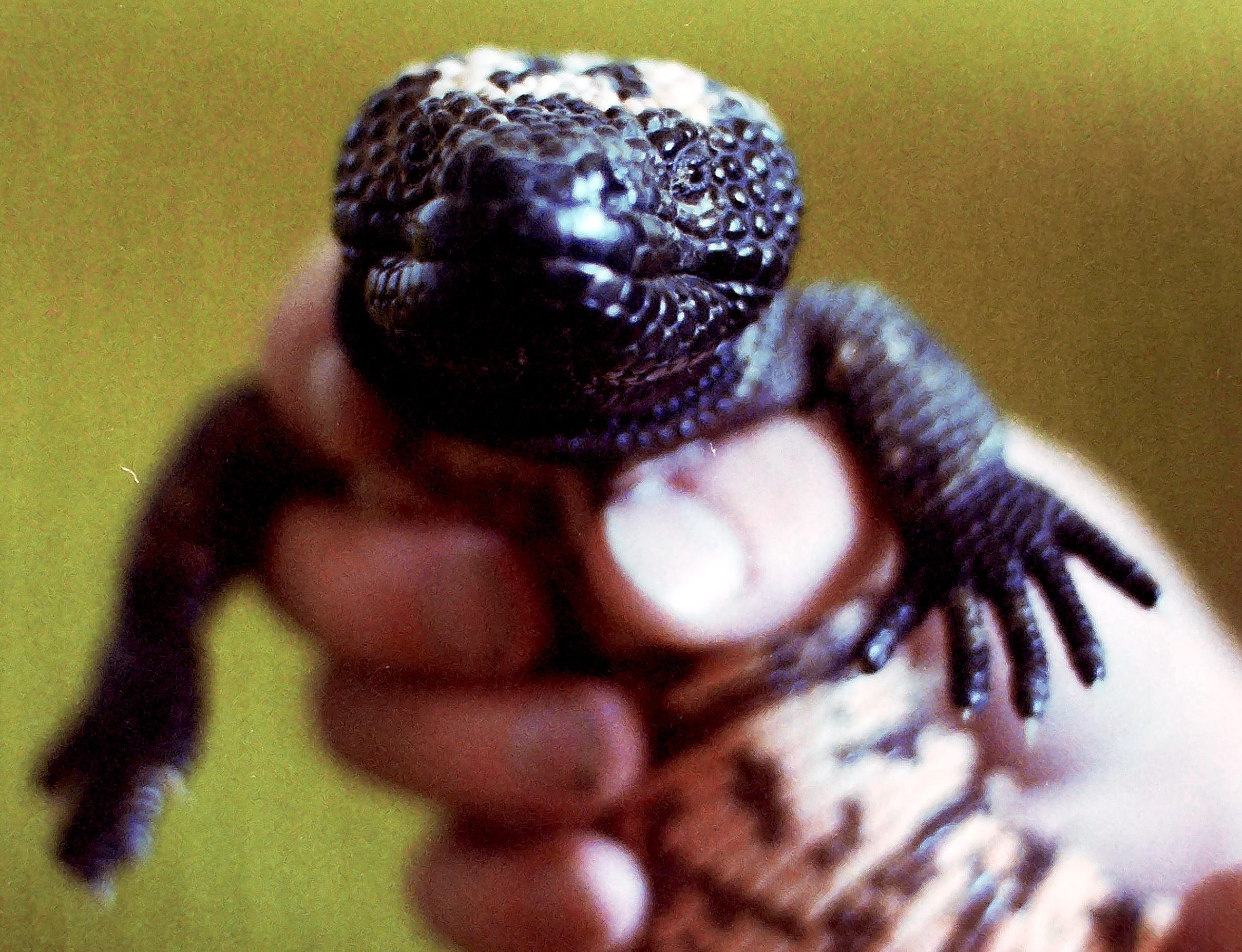
Because of the broad, stocky bodies of Gila monsters, this hold is generally all that is needed to restrain them. They can’t generally turn their heads very far behind them, not that I recommend trying this if you don’t know what you are doing. Holding this grip is much easier than it is to obtain it, particularly with a lizard that is trying to kill you.
As careful and gentle as I was, Lenny wanted no part in being picked up. He kept his mouth open and kept bending himself backward, doing his best to land a bite.
My first goal was to keep him from biting me. My second goal was to do that with the least amount of restraint possible while still achieving the first goal. I did not want to cause any physical discomfort at all. I wanted him to feel fully supported, capable of relaxing and moving in a reasonably normal way so that he felt the least amount of threat to him.
Still, he squirmed, resisted and kept trying to bite for a minute or so. Then, suddenly he stopped. He began flicking his tongue, a sign of some relaxation.
I gently carried him into my living room and sat on the sofa. I was wearing cut-off jeans that exposed my thighs. I carefully rested Lenny on my right thigh.
As cold-blooded animals, one thing I knew most reptiles love is warmth. The heat generated by the warmth of my leg and my hand gently keeping his mouth from biting me would wrap him in a warmth that he would love. At least that was my hope.
I don’t honestly remember how long it took. I was prepared to sit there for a very long time, if needed. But, I didn’t have to sit there for very long. Pretty soon, he started spreading his legs out wider so that he could get more of his belly in contact with my warm leg.
Then, all of a sudden, a big change happened: he took a big inhale and then let out a long, peaceful exhale and as he did, like a seasoned yogi, his whole body fully relaxed and he settled in, blissfully absorbing my body heat the way only a cold-blooded create can.
That big inhale followed by a deep, surrendering exhale became I sign I have used throughout my life to monitor the stress of animals I worked with, including humans. When any air-breathing animal fully relaxes, it’s a thing they do.
After that deep inhale and relaxing exhale, Lenny and I were good friends. He learned to take food from my hands, always careful and seeming to understand where the food ended and my fingers began. He never hissed or tried to bite again. He was even remarkably tolerant of groups of people who liked to gather around after one of my shows. If they were well-behaved, I would let them touch the bead-like scales on his back, as I held his mouth away from them.
When Lenny had enough of that, he would let me know by squirming gently in my hand. That was his way of saying, “I’ve had enough of this for today.”
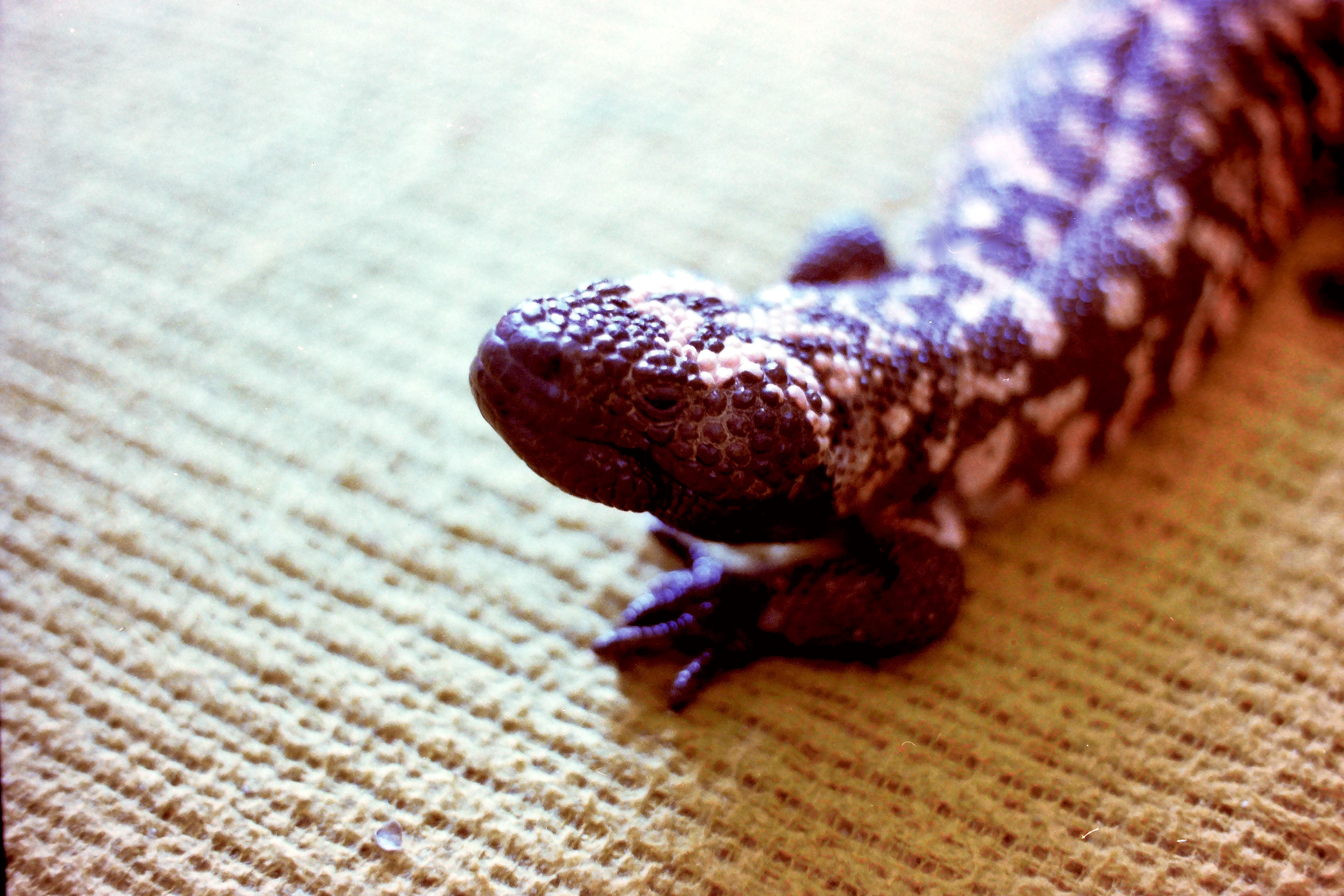
Even with the long passage of time, the jury is still out on whether I was stupid and lucky or knowledgeable and capable. But, I do know that I am forever thankful for getting to know Lenny, an amazing lizard who helped teach many people about how wonderful reptiles can be. He also taught me that if I want to know how a person or animal is doing, I can listen to their breath. The breath never lies and it can tell us all kinds of things about the other beings, human and non-human, in our lives.